간단한 몬테카를로 방법(Montecarlo Method) 예시
몬테카를로 방법은 과학과 공학 전 영역에 걸쳐 널리 사용되는 방법이다. 확률적인 해석을 요구하는 문제를 풀고싶을 때, 이 방법이 주로 쓰인다. 역사적으로는 물리학에서 자주 사용되었다고 전해진다. 1940년도에 원자로의 연쇄 반응 제어를 최초로 실현한 물리학자 엔리코 페르미는 중성자 확산(Neutron Diffusion)을 연구하면서, 이 방법을 자주 사용하였고, 로스앨러모스에서 맨하탄 프로젝트가 수행될 때 현대적인 버전의 몬테카를로 방법이 개발되었다고 전해진다.
참고 Montecarlo
몬테카를로 방법의 가장 간단한 예시로는 원주율(π)의 값을 추정하는 것이다.
넓이가 1인 정사각형을 생각하자. 정사각형의 한 꼭지점을 중심으로 반지름이 1인 사분원을 정사각형 안에 그린다. 그러면 사분원이 차지하는 넓이는 π/4가 될 것이다. 이제, 0 <= x <= 1인 x를 임의로 가져오고, 독립적으로 0 <= y <= 1인 y를 임의로 가져온 후, x^2 + y^2 <= 1일 확률은 사분원이 차지하는 넓이와 같은 값인 π/4가 된다.
이 과정을 여러 번 수행하는 알고리즘을 작성하고, 원주율의 값을 추정하시오.
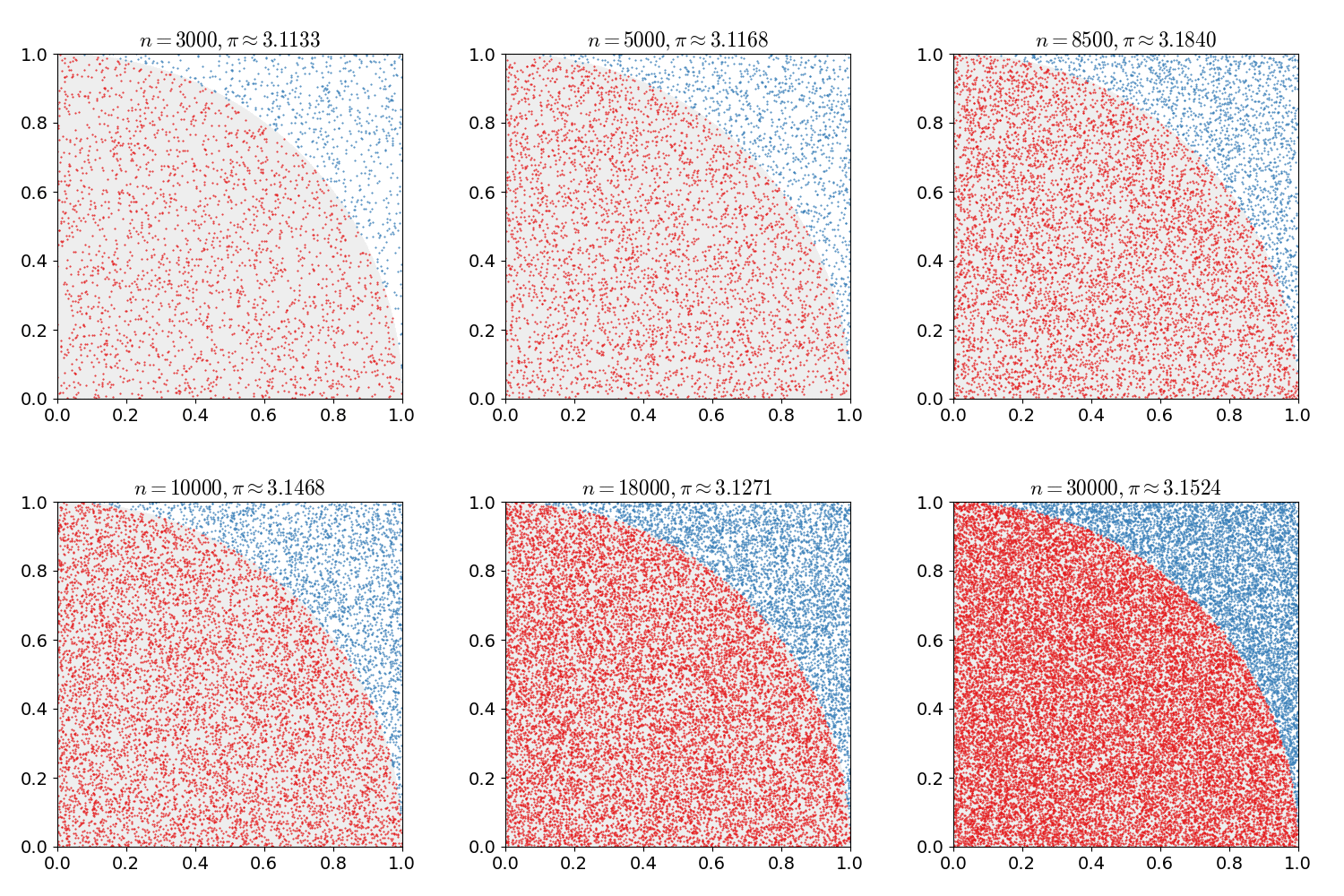
93개의 풀이가 있습니다.
import random
n=int(input("반복 횟수"))
count=0
for i in range(n):
    x=random.uniform(0,1.0)
    y=random.uniform(0,1.0)
    if (x**2+y**2)<=1:
        count=count+1
print("파이값은? ",4*count/n)
double pi=0;
@Test
public void 몬테카를로() {
    LongStream.rangeClosed(1l, 100l).forEach(v -> {
        pi=pi+BigDecimal.valueOf(LongStream.rangeClosed(0, v*3000).filter(x -> (Math.pow(Math.random(), 2) + Math.pow(Math.random(), 2)) <= 1).count()).divide(BigDecimal.valueOf(v*3000), MathContext.DECIMAL128).multiply(BigDecimal.valueOf(4)).doubleValue();
        logger.debug("{} : {}", v*3000, pi / v);
    });
}
@Test
public void 원주율추정() {
    double pi = 0;
    for (int i = 1; i < 100; i++) {
        pi = pi + reckoningPi(i * 3000);
        logger.debug("{} : {}", i * 3000, pi / i);
    }
}

private double reckoningPi(int limited) {
    double count = 0;
    for (double c = 0; c < limited; c++) {
        if (Math.pow(Math.random(), 2) + Math.pow(Math.random(), 2) <= 1) {
            count++;
        }
    }
    return count / limited * 4;
}
Ruby
m_pi = ->n { (1..n).reduce {|_,e|_+(rand(0..1.0)**2+rand(0..1.0)**2>1? 0:1) }*4.0/n }
Test
expect(m_pi[10000]).to be_within(0.1).of(3.1415)
expect(m_pi[20000]).to be_within(0.1).of(3.1415)
expect(m_pi[30000]).to be_within(0.1).of(3.1415)
Out
#=> p m_pi[30000]
3.1489333333333334
#파이썬3.5.1
from random import *
from decimal import *

def montecarlo(n):
    points = []
    for i in range(n):
        points.append((Decimal(uniform(0,1)),Decimal(uniform(0,1))))
    c = 0
    for p in points:
        if p[0]**2 + p[1]**2 <= Decimal(1):
            c += 1
    return Decimal(c)/Decimal(n) * Decimal(4)

while True:
    n = input('How many repeat this program(If you want to stop, input nothing). : ')
    if n == '':
        break
    print('ㅠ will be',montecarlo(int(n))) # 파이를 ㅠ로 표기
public double getProbability(int repeat){
        int total = 0, count = 0;
        double x=0.0, y=0.0 , result = 0.0;
        total =  repeat;


        while(repeat > 0 ){
            repeat--;
            x = (double) Math.random()* 1.0;
            y = (double) Math.random()* 1.0;
            result = x * x + y * y;

            if(result <= 1.0){
                count++;
            }
            System.out.println("x : " + x +"," + "y:"+ y + " = " +result + "count : " + count);


        }
        return (double)count / (double) total;
    }
import random
import math

N=100000
N_in_C=0

for i in range(N):
    x=random.random()
    y=random.random()
    if (x**2+y**2)<1 : N_in_C+=1

Pi_cal=((N_in_C/N)*4)
error=(abs(Pi_cal-math.pi)/math.pi)*100
print("Pi is %f" % Pi_cal)
print("Error rate = %f%%" % error)
dic = {}
for x in range(0, 1, 0.0001)
    for y in range(0, 1, 0.0001)
        if x**2 + y**2 =< 1:
            dic.append{x:y}
len(dic)/10**8 = pi/4
print(pi)
파이썬 처음인데 이게 맞을까요? ㅠㅠ
#include <iostream>
#include <stdlib.h>
#include <time.h>
#include <math.h>
using namespace std;
#define PI 3.141592
int main()
{
    srand((unsigned int)time(NULL));
    int n;
    float x, y;
    float mypi;
    float count = 0;

    cout << "몇 번?"; cin >> n;

    for (int i = 1; i <= n; i++)
    {
        x = (float)rand() / RAND_MAX;
        y = (float)rand() / RAND_MAX;
        if (pow(x, 2) + pow(y, 2) <= 1)
        {
            count++;
        }
    }
    mypi = count / n;
    cout << mypi * 4<< endl;

    return 0;
}
#include <iostream>
#include <stdlib.h>
#include <time.h>
#include <math.h>
using namespace std;
#define PI 3.141592
int main()
{
    srand((unsigned int)time(NULL));
    int n;
    float x, y;
    float mypi;
    float count = 0;

    cout << "몇 번?"; cin >> n;

    for (int i = 1; i <= n; i++)
    {
        x = (float)rand() / RAND_MAX;
        y = (float)rand() / RAND_MAX;
        if (pow(x, 2) + pow(y, 2) <= 1)
        {
            count++;
        }
    }
    mypi = count / n;
    cout << mypi * 4<< endl;

    return 0;
}
import random

count = 10000

def getPi(count):
    undercnt = 0
    for cnt in range(count):
        x = random.uniform(0,1.0)
        y = random.uniform(0,1.0)

        if x**2 + y**2 <= 1:
            undercnt +=1

    return (float(undercnt) / float(count))*4

if __name__ == '__main__':
    print getPi(count)
python 2.7
import random
try:
    n = int(raw_input('how many times ? : '))
    print n

except:
    print 'not integer'

cnt = 0
for i in range(n):
    x = random.uniform(0,1.0)
    y = random.uniform(0,1.0)
    if(x*x + y*y)<=1:
        cnt+=1
pi = 4.0*cnt/n
print pi
위에분꺼 참고해서 작성하다가 추가함 실수로 출력이 안되서
import random

def pi(n):
    count = 0
    for i in range(n):
        x = random.uniform(0, 1)
        y = random.uniform(0, 1)
        if (x**2 + y**2) <= 1:
            count += 1
    return 4 * count / n

print(pi(56000))
print(pi(10000))
package main

import (
    "fmt"
    "math/rand"
)

func main() {
    for j := 1; j < 10; j++ {
        count := 3000 * j
        small := 0
        for i := 0; i < count; i++ {
            x := rand.Float64()
            y := rand.Float64()
            calc := x * x + y * y
            if calc <= 1 {
                small++
            }
        }
        fmt.Println(float64(small) / float64(count))
    }
}
import random as rd
from ctypes import *
from multiprocessing import Process, Queue

PROCESS = 8
MULTIPLY = 2**20 #동기화 간격. 적으면 병목 발생.
n = i = 0
def f(q):
    while 1:
        li = []
        for x in range(MULTIPLY):
            li.append((rd.random()**2+rd.random()**2<=1))
        q.put([li.count(True), len(li)])


if __name__ == '__main__':
    proc = []
    q = Queue(maxsize = 1000)
    for x in range(PROCESS):
        proc.append(Process(target = f, args = (q,)))
        proc[x].start()

    while 1:
        temp = q.get()
        i += temp[0]; n += temp[1]
        print(4*i/n)
멀티프로세스로 계산했습니다. 병목 현상 발생해서 나름 고쳐보았습니다. 파이썬 3.5.1 64
from random import random

count = 0

for i in range(30000):
    if random()**2+random()**2 <= 1:
        count += 1

print(4*count/i)
짧게 짰습니다
GCC
i;
main(j){
srand(time(0));
for(i=10000;i--;pow(rand(),2)+pow(rand(),2)<1073676290&&j++);
printf("%f",j/2500.);
}
import random
n=int(input('몇 회 반복할까요? '))

count=0
for k in range(n):
    x=random.random()
    y=random.random()
    if x**2+y**2<=1:
        count+=1
    pi=(count/(k+1))*4
    if (k+1)%10000==0:
        print('%d회 실시 결과 pi=%0.10f' %(k+1, pi))
print('추정된 pi=%0.10f' %pi)
import random
count = int(input("수행횟수 : "))
stack=0
for i in range(count):
    ii=random.random()
    jj=random.random()
    if ii**2 + jj**2 <=1 :
        stack+=1
pi=stack*4/count
print("%d 의 수행으로 얻을 수 있는 pi값 : %f"%(count,pi))
Python 3.5.2
matrix_size = 10000
x = 0
y = 0
in_num = 0
for i in range(matrix_size) :
    for j in range(matrix_size) :
        if (x**2 + y**2) <= 1 : in_num +=1
        x = x + (1 / matrix_size)
    y = y + (1 / matrix_size)
    x = 0
print(in_num / matrix_size**2 * 4)
코드 정리는 하지 아니하였습니다. 처음 Random 함수를 이용하여 풀어 봤지만 시행 횟수가 많아지면 질수록 중복값의 우려 때문에..
저 도표를 보니 더 규칙적이고 조밀하게 만들면 더 좋을꺼 같아 이렇게 해봤습니다. 행렬 사이즈가 커지면 커질 수록 더 값이 정교하게 나오네요
#include <stdio.h>
#include <stdlib.h>
#include <time.h>
int main() {
    srand(time(0));
    double x = 0;
    double y = 0;
    double circle = 0;
    double total = 0;

    for(int i = 0; i < 100000; i++) {
        x = (double)rand() / (double)RAND_MAX;
        y = (double)rand() / (double)RAND_MAX;
        total++;
        if((x * x) + (y * y) <= 1) {
            circle++;
        }
    }

    printf("%f\n", (circle / total) * 4);
}
Java
import java.util.Random;

public class PiTest {
    public static void main(String[] args) {
        Random RANDOM = new Random();
        int withinCircleCount = 0;
        int totalCount = Integer.MAX_VALUE;
        for (int i = 0; i < totalCount; i++) {
            if (Math.pow(RANDOM.nextDouble(), 2) + Math.pow(RANDOM.nextDouble(), 2) <= 1d) {
                withinCircleCount++;
            }
        }
        System.out.println(4*(double)withinCircleCount / (double)totalCount);
    }
}
결과 : 3.141641342612748
랜덤이 아닌 x, y 값을 조금씩 늘여서 계산
public class PiTest2 {
    public static void main(String[] args) {
        double accuracy = 0.000003;
        double withinCircleCount = 0, totalCount = 0;
        for (double i = 0; i <= 1; i += accuracy) {
            for (double j = 0; j <= 1; j += accuracy) {
                totalCount++;
                if (Math.pow(i, 2) + Math.pow(j, 2) <= 1d) {
                    withinCircleCount++;
                }
            }
        }
        System.out.println(4*withinCircleCount / totalCount);
    }
}
결과 : 3.1415920915270674
C#
public double SimpleMontecarloMethod(int nTimes)
        {
            double x = 0;
            double y = 0;
            Random rnd = new Random();
            double Count = 0;

            for (int i = 0; i < nTimes; i++)
            {
                x = rnd.NextDouble();
                y = rnd.NextDouble();

                if ((x * x + y * y) <= 1)
                {
                    Count++;
                }
            }

            return 4 * (Count / nTimes);

        }
이걸 몇 번 시행해서 평균값 같은 걸 내고.. 그런 과정도 필요한건가요?
import random


def test(n=1000000):
    t = 0
    for _ in range(n):
        x, y = random.random(), random.random()
        if not (x**2 + y**2)**0.5 > 1:
            t += 1
    return t / n * 4

print("{:0.9f}".format(test()))
안녕하세요 c++로 풀어봤습니다.
#include<iostream>
#include<time.h>

using namespace std;

void main()
{
    cout<<"Hello Stranger!?"<<endl;

    int n = 0;
    double s = 0;

    cout<<"input N"<<endl;
    cin>>n;

    srand(time(0));

    for(int i=0; i<n; i++)
    {
        double x = (double)rand()/RAND_MAX;
        double y = (double)rand()/RAND_MAX;
        double res = x*x + y*y;

        if(res <= 1)
            s++;
    }
    s = s/n*4;

    cout<<s;
}
import random
def do(n):
    p = 0
    for i in range(n):
        x = random.random()
        y = random.random()
        p+=1 if x**2 + y**2 <=1 else 0
    return n, p / n * 4

print(do(6000))
print(do(12000))
print(do(24000))
print(do(27000))
print(do(30000))
print(do(60000))
print(do(120000))
Python 3.5.2에서 작성하였습니다.
import random
result, count, p_count = 0,1,0
tmp = list()
while p_count < 30000:
    x = random.random()
    y = random.random()
    result = x**2+y**2
    if result <= 1:
        p_count += 1
    count += 1
print('%.5f' % (p_count/count*4))

#### 2017.01.24 D-394 ####
import random
result, count, p_count = 0,1,0
tmp = list()
while p_count < 30000:
    x = random.random()
    y = random.random()
    result = x**2+y**2
    if result <= 1:
        p_count += 1
    count += 1
print('%.5f' % (p_count/count*4))

#### 2017.01.24 D-394 ####
import random
def pi_cal(n):
    print(sum((random.uniform(0,1)**2+random.uniform(0,1)**2<=1) for i in range(n))/n*4)
pi_cal(500000)
import random
n=1000000
n1=0
for i in range(n):
    x=random.random()
    y=random.random()
    if (x**2+y**2)<=1:
        n1+=1
pi=(n1/n)*4
print('n={0}, pi={1:0.5f}'.format(n,pi))
MATLAB으로 짜보았습니다. 1천만번 (1e7) 테스트입니다. 만번 (1e4) 때부터 거의 수렴하는 것 같네요.
N_max=1e7;
n=0;
sol_cnt=0;

converge_check=zeros(N_max,1);
while n < N_max
    n=n+1;
    x=rand(1,1);
    y=rand(1,1);
    if (x^2+y^2) < 1^2
        sol_cnt=sol_cnt+1;
    end
    if mod(n,100000)==0
        disp([num2str(n) 'th trial -> ' num2str(sol_cnt/n*4)]);
    end
    converge_check(n)=sol_cnt/n*4;
end

%%
figure;
semilogx((1:N_max),pi*ones(1,N_max),':k');
hold on;
semilogx((1:N_max),converge_check);
axis([1 N_max 3-1.5 3+1.5]);
```{.python} import random while(True): number = int(input('반복하는횟수: ')) j = 0 for i in range(1,number+1): x=random.random() y=random.random() if((x2)+(y2)<=1): j=j+1 print((j/number)*4)
```3.6 python
Python 3.6 using random.random()
from random import random


def monte_pi(n):
    inner, total = 0, 0
    while total <= n:
        total += 1
        if random()**2 + random()**2 <= 1:
            inner +=1
    return 4 * (inner/total)

>>> monte_pi(30000)
3.1413619546015132
javascript
var distance = (x, y) => Math.sqrt(x * x + y * y);

var guessPI = function(r) {
    return Array.from(Array(r)).reduce(v => v + (distance(Math.random(), Math.random()) <= 1 ? 1 : 0), 0) / r * 4
}

var repeat = [3000, 4000, 5000, 6500, 8500, 10000, 15000, 18000, 24000, 30000, 300000, 999999];
for (r of repeat) {
    console.log(`${r} : ${guessPI(r)}`);
}
아래는 guessPI 의 loop 버전
코딩도장에서 loop 를 functional 로 배우는 기법을 많이 배우네요.
아직 모르는 언어이지만, Ruby 나 python 코드를 훔쳐보고 있어요.
그리고 javascript ES6 스타일로 많이 적용해보고 있습니다.
var guessPI = function (repeat) {
    var inner = 0;
    for (let i = 0; i < repeat; i++) {
        if (distance(Math.random(), Math.random()) <= 1) inner++;
    }

    return inner / repeat * 4;
};
저장용
def prob(n):
    import random
    count=0
    for i in range(n):
        x, y = random.random(), random.random()
        if x**2+y**2<=1:
            count += 1
    return print('pi ~',4*count / n)
from random import uniform as U

def Montecarlo(n):
    p = [(U(0,1), U(0,1)) for _ in range(n)]
    cnt = sum([x*x+y*y <= 1 for (x, y) in p])
    return 4 * cnt / n


print(Montecarlo(1000000))
C++입니다 ~
여러 수학공식들이 많네요 !
#include <iostream>
#include <cstdlib>
#include <cmath>
#include <ctime>
#define ele int
using namespace std;

double random(void) {
    return pow(rand() / (double)RAND_MAX,2);
}

int main() {
    ele chk = 0, cnt;
    srand(time(NULL));
    cout << " 반복 횟수 : "; cin >> cnt;

    for(ele i=0;i<cnt;i++) random() + random() <= 1 ? chk++ : 0;
    // 확률 = 파이/4  , 원주율 = 파이 = 확률*4
    cout << " 원주율(파이) : " << (double)chk / cnt  * 4 << endl;

    return 0;
}
from random import random
def pi(n):
    return 4.0 * sum([1 for x in range(n) if random()**2 + random()**2 < 1]) / n
print(pi(10000))
x제곱 + y제곱이 1보다 작은 확률을 사각형의 넓이와 곱하여 원의 넓이를 계산하고 원의 크기의 4분의 1인 pi/4가 같다고 놓고 계산함
import random

def pi(n):
    shot = 0
    for i in range(n):
        x = random.random()
        y = random.random()
        if x*x + y*y < 1:
            shot += 1
    return shot/n*4

print(pi(100000))
import random as rd

def findpi(n):
    tmp=0
    for i in range(n):
        x,y=rd.uniform(0,1),rd.uniform(0,1)
        if x**2+y**2<=1: tmp+=1
    return(tmp*4/n)

num=int(input())
print(findpi(num))
Java 입니다.
public class level_2_Montecarlo_Method {
public static void main(String[] args) {

    System.out.println("몬테카를로 방법을 수행할 횟수를 입력하세요. (횟수는 적당히.)");
    Scanner sc = new Scanner(System.in);
    double number = sc.nextDouble();
    sc.close();

    double count = 0;

    for(int i = 0; i < number; i++)
    {
        double x = 0;
        double y = 0;
        x = Math.pow(Math.random(), 2); // 0이상 1미만의 무작위 실수들.
        y = Math.pow(Math.random(), 2); // 0이상 1미만의 무작위 실수들.

        if(x + y <= 1)
        {
            count++;
        }
    }
    System.out.println("x^2 + y^2 <= 1일 확률 : " + count / number);
    System.out.println("추정되는 원주율의 값은 약 : " + (count / number) * 4);
}
}
파이썬 3.6
import math

def calpai(n):
    a,π = 0,0
    t = round(math.sqrt(n))
    for i in range(0,t+1):
        for h in range(0,t+1):
            x = i/t
            y = h/t
            if 0 <= x <= 1 and 0 <= y <= 1:
                if x**2 + y**2 <= 1: a += 1
                else: break
# 확률(P) = 사건A(x^2 + y^2 <= 1)가 일어나는 경우의 수(a) / 모든 경우의 수(n)
# π = 4 * (a / n)( ∵ π/4 = a / n)
    print("n = %d, π ≈ %.4f" %(n,4 * (a/n)))

if __name__ == "__main__":
    data = [3000,5000,6500,8500,15000,18000,24000,30000,1000000]
    for n in data:
        calpai(n)
- 결과값
n = 3000, π ≈ 3.2333
n = 5000, π ≈ 3.2200
n = 6500, π ≈ 3.2185
n = 8500, π ≈ 3.1689
n = 15000, π ≈ 3.1469
n = 18000, π ≈ 3.1633
n = 24000, π ≈ 3.1703
n = 30000, π ≈ 3.1559
n = 1000000, π ≈ 3.1456
랜덤 쓰지 않고 쌩으로 점하나 하나 찍어 면적 구하기
# 파이썬

in_circle = 0
n = 2000

for x in range(0, n):
    for y in range(n, x, -1):
        if x**2 + y**2 <= (n)**2:
            in_circle += 1

print(4*in_circle / (n**2/2))
# 3.142172
랜덤 썼을 때.
import random
random.seed(0)

in_circle = 0
n = 2000000

for _ in range(n):
    x = random.uniform(0, 1)
    y = random.uniform(0, 1)
    if x**2 + y**2 <= 1:
        in_circle += 1

print((in_circle/(n+1))*4)
# 3.1416324291837854
import random
i = j = 0
n = int(input("반복 횟수 :"))
while i <= n:
    i += 1
    x = random.random()
    y = random.random()
    if x*x+y*y <= 1:
        j +=1
print(4*j/i)
import numpy

AttempN = [50000, 100000,  500000]
for i in AttempN:
    print("pi ~ ", sum(1 for j in range(i) if numpy.linalg.norm(numpy.random.rand(1,2)) <=1)/i*4)
#include <stdio.h>
#include <stdlib.h>

int main()
{
    int attemp_n, count=0;
    float x, y;

    while (1) {
        printf("실행 횟수를 입력하시오. ");
        scanf_s("%d", &attemp_n);
        for (int i = 1; i < attemp_n + 1; i++) {
            x = (float)rand()/RAND_MAX; y = (float)rand()/RAND_MAX;
            if ((x*x) + (y*y) <= 1) count++;
        }
        printf("%d회 실행의 Pi의 추정치는 %f입니다.\n", attemp_n, (float)count / (float)attemp_n * 4.0f);
        count = 0;
    }

    return 0;
}
Python
import random

n = 10000000
prob = 0
for i in range(n):
    x = random.random()
    y = random.random()
    if x**2 + y**2 <= 1:
        prob += 1
    if i%100000 == 0 and i != 0:
        print("N = {}, pi = {}".format(i, 4*prob/i))
ans = 4*prob/n
print(ans)
import sys
import random as rd

test_count = int(sys.argv[1])
in_circle = 0

for i in range(test_count):
    x = rd.uniform(0,1.0)
    y = rd.uniform(0,1.0)

    if x**2 + y**2 < 1:
        in_circle += 1

pi = (in_circle / test_count) * 4
print(pi)
public class Main {
    public static void main(String[] args) {
        int count = 0, total = 100000000;
        for (int i = 0; i < total; i++)
            if (Math.pow(Math.random(), 2) + Math.pow(Math.random(), 2) <= 1)
                count++;
        System.out.println(count * 4 / total);
    }
}
파이썬 3.
from random import random

total_count = 0
inside_count = 0
while total_count < 1000000:
    total_count += 1
    x, y = (random(), random())
    if x**2 + y**2 <= 1:
        inside_count += 1

pie = (inside_count / total_count) * 4
print(pie)
from random import *

for n in range(5000,100001,1000):
    noc = 0
    for i in range(n):
        if random()**2+random()**2 <= 1: noc += 1
    print('n = {:6}, π ≒ {:.7}'.format(n,4*noc/n))
C#
using System;

namespace CD108
{
    class Program
    {
        static Random position = new Random();

        static void Main()
        {
            int tryCase = 5_000_000;
            Console.WriteLine($"n = {tryCase}, pi = {GetPiValue(tryCase)}");
        }

        static double GetPiValue(int tryCase)
        {
            double posX, posY;
            int count = 0;
            for (int i = 0; i < tryCase; i++)
            {
                posX = position.NextDouble();
                posY = position.NextDouble();
                if (posX * posX + posY * posY <= 1.0) { count++; }
            }
            return (double)count / tryCase * 4.0;
        }
    }
}
import java.util.Random;

public class KimSanghyeop
{
    public static void main(String[] args)
    {
        double x;
        double y;

        Random rd = new Random();

        int f1;
        int f1_max= 100000;
        int cnt=0;


        for(f1=0;f1<f1_max;f1++)
        {
            x=rd.nextDouble();
            y=rd.nextDouble();

            if(x*x + y*y <=1)
            {
                cnt+=1;
            }

            if(f1 % 2000 ==0)
            {
                System.out.println(f1+" : "+ 4.0*cnt/f1);
            }
        }
    }
}
n <- 1000000
ct <- 0

for (i in 1:n){
  x <- runif(1, min = 0 , max = 1)
  y <- runif(1, min = 0 , max = 1)

  if(x ^ 2 + y ^ 2 <= 1){
    ct <- ct + 1
  }
}

pi <- 4 * ct / n
def find_pi(repeats):
    import random
    area_square = 0
    area_circle = 0
    for rep in range(repeats):
        x = random.random()
        y = random.random()
        if x ** 2 + y ** 2 <= 1:
            area_circle += 1
        area_square += 1
    return area_circle * 4 / area_square
print(find_pi(1000000))
from random import random

def montecarlo(n):
    per = 0
    for i in range(n):
        if random()**2+random()**2 <= 1:
            per += 1
    return per/n*4
>>> montecarlo(10)
3.2
>>> montecarlo(100)
3.16
>>> montecarlo(1000)
3.252
>>> montecarlo(10000)
3.1288
>>> montecarlo(100000)
3.14824
>>> montecarlo(1000000)
3.14236
>>> montecarlo(10000000)
3.1415864
import random

n= int(input())
count = 0
for i in range(n):
    x = random.uniform(0, 1.0)
    y = random.uniform(0, 1.0)

    if (x*x + y*y) <= 1:
        count += 1

print(4*count/n)
import random
piData = []
for i in range(1, 30000 + 1) :
    x = random.random()
    y = random.random()
    won = x**2 + y**2
    if  won <= 1 :
        pi = len(piData) / i * 4
        piData.append(pi)
    if i % 5000 == 0 :
        print("n = %d, π ≒ %0.4f"%(i, pi))
# 파이썬 3
i = 0
z = 0

for i in range(10000000):


  x = random.uniform(0,1)
  y = random.uniform(0,1)

  if x**2 + y**2 <= 1:
    i += 1
  else:
    z += 1

print(i / (i+z) * 4)
import random
count=0
for i in range(10000000):
    x = float(random.random())
    y = float(random.random())
    if (x**2 + y**2)**0.5 <=1:
        count += 1
    else:
        pass

print(count / 10000000 * 4)
import random

def Monte(n):  #n은 알고리즘을 수행하는 횟수
    t = 0
    for i in range(n):
        x, y = random.random(), random.random()
        if x**2 + y**2 <= 1: t += 1  #t는 사분원에 들어간 횟수
    return 4 * (t/n)
>>> print(Monte(10)) #10번

2.0
>>> print(Monte(100)) #100번

3.28
>>> print(Monte(1000)) #1000번

3.224
>>> print(Monte(10000)) #10000번

3.1404
>>>
from random import *
n=int(input());p=0

for i in range(n):
    x=random();y=random()
    if x*x+y*y<=1:
        p+=1

print("π="+str(4*p/n))
확률이라고 해서 무슨 말인가 했읍니다 .이번 문제는 랜덤모듈을 끌어와서 실용하여 본 좋은 예제였읍니다.^^
python
import random as rd
n = int(input())
count = 0
for i in range(n):
    x = rd.uniform(0,1)
    y = rd.uniform(0,1)
    if x**2 + y**2 <= 1:
        count += 1
print("π = ",4*count/n)
cnt =0
for n in range(1,50001):
    x,y = np.random.rand((2))
    if x**2 + y**2 <= 1:
        cnt+=1
    if n%1000==0:
        print("n={0}, pi={1}".format(n,(4*cnt/n)))
var 총횟수 = 1000;
      var 원내부위치 =0;
      for (var i = 0; i < 총횟수; i++) {
        var x = Math.random();
        var y = Math.random();
        if (x**2+y**2<1) {
          원내부위치++
        }
      }
      console.log('pi/4=',원내부위치/총횟수)
      console.log('pi=',원내부위치/총횟수*4)
number = 0
파이를 좀 더 정확하게 구하는 넘버
m = 1000
for x in range(0, m): for y in range(0, m): if (x2 + y2) <= (m*m) : number += 1
ramnum = number / (m*m) print(ramnum) result = (ramnum) * 4 print(result)
import time
import random


def pi_MontecarloMethod(randtime):
    start = time.time()
    cin = 1

    for cnt in range(randtime):
        x = random.uniform(0, 1)
        y = random.uniform(0, 1)

        if (x**2 + y**2) <= 1:
            cin += 1

    res = cin*4 / randtime
    runtime = time.time()-start
    return res, str(runtime)[0:10]


if __name__ == '__main__':
    cnt = int(input('input count time : '))
    print()

    print('calculating...\n')
    pi = pi_MontecarloMethod(cnt)

    print('pi : ', pi[0])
    print('runtime :', pi[1], 'seconds')
public class 간단한몬테카를로방법 {

    public static void main(String[] args){

        double count = 0.0;
        for(double i=1; i<30001; i++) {  //예제에서와 같이 30000번 실행
            double x = Math.random();  //x에 난수 0.0~1.0사이의 난수 생성
            double y = Math.random();  //y에 난수 생성
            if(x*x+y*y<=1) {   //x^2 + y^2의 값이 1보다 작거나 같으면 count++;
                count++;
            }
            if(i%1000==0) {   //1000 단위로 값을 출력
                System.out.printf("%.4f\n", (count/i)*4); //소수점 4번째 자리까지 출력
            }
        }
    }
}
import random

x_list, y_list, count = [], [], 0

for n in range(int(input("N : "))) :
    x_list.append(random.uniform(0, 1))
    y_list.append(random.uniform(0, 1))

    if (x_list[n])**2+(y_list[n])**2 <= 1 :
        count +=1
    else : continue
print((count/n)*4)
결과
N : 100000
3.142111421114211
파이썬3입니다.
import random
a = int(input('몇번 반복하시겠습니까?'))
result = 0
for i in range(a):
  x, y = random.uniform(0, 1), random.uniform(0, 1)
  if x**2 + y**2 <= 1:
    result += 1
print('파이값은 {:0.4f} 입니다.'.format(4*result/a))
mport random

count = int(input("반복 횟수 : "))
num = 0
for i in range(count):
    x = random.random() #random 모듈의 random() 0 이상 1 미만
    y = random.random()

    if (x**2 + y**2) <= 1:
        num +=1
print("PIE : ", num/count * 4)
문제를 이해를 못해서 다른사람 풀이 과정을 모방했습니다.
import random
repeat = 10000000
in_circle = 0
for i in range(repeat):
    x = random.random()
    y = random.random()
    t = x**2 + y**2
    if t <= 1:
        in_circle +=1
print(in_circle/repeat*4)
import random
yes=0
for i in range (1,50000000):
x=random.random()
y=random.random()
if(x**2+y**2<=1):
yes=yes+1
print ((yes/i)*4 )
파이썬 3.8로 작성했습니다.
# http://codingdojang.com/scode/507#answer-filter-area
n=int(input("반복 횟수를 입력해 주세요"))
import random
count=0
# a2+b2<=1이면 count+1
for i in range(n):
    a=random.random()
    b=random.random()
    if a**2+b**2<=1:
        count+=1
print(4*count/n)
import random

n=100000
count=0
for i in range(n):
  x=random.random()
  y=random.random()
  if(x*x+y*y<1):
    count=count+1
a=4*count/n
print(a)
from random import *

def monte_carlo():
    trial = 1000000
    count = 0
    for i in range(trial):
        count += 1 if random() ** 2 + random() ** 2 <= 1 else 0
    return 4 * count / trial
from random import *
n = int(input())
algogo = []
cnt = 0
for i in range(n):
    x = uniform(0,1)
    y = uniform(0,1)
    if x**2+y**2 <= 1:
        cnt += 1
    else:
        continue
print(4*cnt/n)
import random

t = 0
f = 0
for i in range(1, 100001):
    x = random.uniform(0, 1)
    y = random.uniform(0, 1)
    if x ** 2 + y ** 2 <= 1:
        t += 1
    else:
        f += 1
    if i % 1000 == 0:
        print("n = {},pi = {}".format(i, t / (t + f) * 4))
import random as r
def Montecarlo_Method(number):

  count=0

  for i in range(number):

    x=r.uniform(0,1.0)

    y=r.uniform(0,1.0)

    if x*x+y*y<=1:

      count+=1


  return str(4*(count/number))

def main():

  numbers=int(input("wirte number"))

  print(Montecarlo_Method(numbers))

main()
import random

def monte(n):
    count = 0
    for i in range(1, n+1):
        x = random.uniform(0, 1)
        y = random.uniform(0, 1)
        if x**2 + y **2 <= 1:
            count+=1
    pi = (count/i)*4
    return pi

print(f'1000: {monte(1000)}')
print(f'10000: {monte(10000)}')
print(f'100000: {monte(100000)}')
print(f'1000000: {monte(1000000)}')
import random

loop = int(input("반복횟수를 입력하세요 : "))
count=0
i=0
while i<loop:
    x = random.uniform(0,1.0)
    y = random.uniform(0,1.0)
    if x**2+y**2<=1:
        count+=1
    i+=1

print("원주율은 {}".format(count/loop*4))
import random

def monte(n):
    n_inside = 0

    for i in range(n):
        x = random.uniform(0, 1.0)
        y = random.uniform(0, 1.0)
        if x**2 + y**2 <= 1:
            n_inside += 1

    return n_inside/n

print(monte(10000))
print(monte(100000))
print(monte(1000000))
python 3.9.4로, 원주율의 값을 15회마다 출력하는 것을 1000번 반복하였습니다.
import random


x = 0
y = 0
dots_in_square = 0
dots_in_circle = 0
pi = 0


for i in range(1, 1001):
    for j in range(15):
        x = random.random()
        y = random.random()
        distance_from_origin = x**2 + y**2
        dots_in_square += 1
        if distance_from_origin <= 1:
            dots_in_circle += 1
    pi = (dots_in_circle / dots_in_square) * 4
    print("====================%sth generation====================" % i)
    print("pi is %s" % pi)
결과는 다음과 같습니다.
====================1th generation====================
pi is 2.933333333333333
====================2th generation====================
pi is 3.2
====================3th generation====================
pi is 3.3777777777777778
====================4th generation====================
pi is 3.3333333333333335
====================5th generation====================
pi is 3.2
(...생략...)
====================996th generation====================
pi is 3.1386880856760375
====================997th generation====================
pi is 3.1384821130056837
====================998th generation====================
pi is 3.1382765531062122
====================999th generation====================
pi is 3.1383383383383383
====================1000th generation====================
pi is 3.1386666666666665
import random, math

def is_in(r):
    x = random.random()*r
    y = random.random()*r
    return (x-r)**2 + (y-r)**2 <= r**2

run = int(input('실행할 회수를 입력하세요.: '))

cnt = 0

for _ in range(run):
    if is_in(1):
        cnt += 1
estimate_pi = (cnt/run)*4

print(f'pi 추정치:', round(estimate_pi, 5))
print(f'pi    =   ' , round(math.pi, 5))
#codingdojing_montecarlo_method

# x^2 + y^2 = 1
# y = (1-x^2)*(1/2)

from random import random

def monte(n):

    cnt = 0
    for i in range(n):
        x = random()
        y = random()
        if x**2 + y**2 <= 1: cnt += 1

    # percentage = pi/4
    pi = 4*(cnt/n)
    return pi

print(monte(1000))
print(monte(10000))
print(monte(30000))
print(monte(100000))
print(monte(1000000))
print(monte(10000000))
print(monte(100000000))
3.284 3.1276 3.1544 3.13748 3.139796 3.1408744 3.14154508
import random
def Montecarlo_Method(a):
    cnt = 0
    for i in range(a):
        b = random.uniform(0,1)
        c = random.uniform(0,1)
        if b*b + c*c <= 1:
            cnt += 1
    π = (4*cnt)/a
    return π


if __name__ == '__main__':
    a =  int(input("반복횟수입력:"))
    print(Montecarlo_Method(a))
import random

n = int(input("수행 횟수"))
p= 0

for i in range(1,n+1):
    x = random.random()
    y = random.random()
    if x**2 +y**2 <=1:
        p +=1

probabilty = p/n
pi = probabilty*4

print(probabilty)
print(pi)
import random
import math
import matplotlib as mpl
import matplotlib.pylab as plt

def mcr(n):
    a=[random.random() for x in range(n)]
    b=[random.random() for x in range(n)]
    c=[math.sqrt(a[x]**2+b[x]**2) < 1 for x in range(n)]
    #print(c)
    return c.count(True)/n*4

mcr(1000000)

z = 7
x = [10**i for i in range(2, z)]
y = [mcr(j) for j in x ]

fig, ax = plt.subplots(figsize=(5, 2.7))
ax.plot(x, y, '-o', mfc='orange');
from random import random

n=10000
num=0
for rep in range(1,n):
    x, y=random(), random()

    if x**2+y**2<=1:
        num+=1

print(num/n*4)
import random
n = int(input("수행할 횟수 입력 :"))
count = 0
n_count = 0

while count + n_count != n:
    x = random.random()
    y = random.random()
    if (x ** 2) + (y ** 2) <= 1:
        count += 1
    else:
        n_count += 1

result = count / n * 4

print(result)
import random

def monte(n):
    count = 0
    for i in range(0,n):
        x = random.random()
        y = random.random()
        if x**2 + y**2 <= 1:
            count += 1
    return count/n

print(monte(100000)*4)
import random

cmd = int(input("반복할 횟수를 입력하시오: "))
count = 0

for i in range(cmd):

    x = random.random()
    y = random.random()

    PI = x * x + y * y

    if PI <= 1:
        count += 1

print(f"파이값은 {4*count/cmd}이다")

``````{.python}
import random

cmd = int(input("반복할 횟수를 입력하시오: "))
count = 0

for i in range(cmd):

    x = random.random()
    y = random.random()

    PI = x * x + y * y

    if PI <= 1:
        count += 1

print(f"파이값은 {4*count/cmd}이다")
import random
n = input('몬테카를로 방법을 통해 원주율의 값을 추정하는 함수 입니다. \n반복할 숫자를 입력해주세요 : ')
in_circle = [1 for i in range(int(n)) if random.random()**2 + random.random()**2 <= 1]
print(4*len(in_circle)/int(n))
import random

n = 0
count = 0
cnt = 0
res = 0
while True:
    n += 1
    x = random.uniform(0, 1.0)
    y = random.uniform(0, 1.0)
    if (x**2 + y**2) <= 1:
        count += 1

    a = random.random()
    b = random.random()
    if (a**2 + b**2) < 1:
        cnt += 1
    if n > 5000 + res * 5000 and 3.14 < 4 * count / n < 3.145:
        print(n, "번 시행: 파이값은? ", 4 * count / n, '\n\t\t\t\t:  pi = ', 4 * cnt / n)
        res += 1
        if res > 2:
            break