k-palindrome
출처: http://www.careercup.com/question?id=6287528252407808
페이스북 필기 문제 중 하나.
k-palindrome 은 문자열에서 최대 k개의 문자를 제거했을 때 palindrome이 되는 문자열을 말한다.
문자열 S와 정수값 K가 주어질 때 주어진 문자열이 k-palindrome일 경우 "YES", 아닐경우에는 "NO"를 출력하시오. (단, S의 최대길이는 20,000, K의 범위는 0<=K<=30)
※ 팔린드롬(palindrome) - 바로 읽든 거꾸로 읽든 결과가 같아지는 단어, 문구, 숫자를 말한다. (예: 'eye', 'Madam', '아들딸들아')
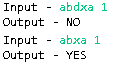
샘플 예:
Input - abxa 1
Output - YES

Input - abdxa 1
Output - No
38개의 풀이가 있습니다.
k가 30밖에 안 되니까 그냥 하면 됩니다. k가 더 커진다면 memoization 정도는 필요하겠죠.
#include<iostream>
#include<string>
using namespace std;


bool is_k_palin(string &s, int k, int first_index, int last_index)
{
    if (k < 0) return false;
    if (first_index >= last_index) return true;

    bool result = false;
    if (s[first_index] == s[last_index]){
        result = is_k_palin(s, k, first_index + 1, last_index - 1);
    }
    else
    {
        result = is_k_palin(s, k - 1, first_index + 1, last_index)
                 || is_k_palin(s, k - 1, first_index, last_index - 1);
    }
    return result;
}

int main(){
    string s;

    int k;
    while (true){
        cout << "Input - ";
        if (!(cin >> s >> k))
            break;
        cout << "Output - ";
        if (is_k_palin(s, k, 0, s.length() - 1))
            cout << "YES\n";
        else
            cout << "NO\n";
    }
    return 0;
}
k의 최대값이 30이라는 게 함정인듯합니다. 이게 얼마안된다고 재귀로 들어갔다가는 문자열의 길이가 길어지면 대책없이 오래 걸려서 몇일 고민했네요....
acxa 가 k-palindrome 이 되는지 보려면 k 번 삭제하기 전에 회문이 됩니다. 이를 뒤집어서 생각해보면
뒤집은 문자열 axca 로부터 삽입이나 삭제를 k * 2 번 해서 원래의 문자열을 만들 수 있으면 됩니다.
이는 편집거리 문제가 돼서 DP로 풀 수 있습니다.
#   #   a   x   c   a
#   0   1   2   3   4
a   1   0   1   2   3
c   2   1   2   1   2
x   3   2   2   2   3
a   4   2   3   3   2
이 경우의 최소 편집거리는 2이며 이는 1 * 2 이므로 1-회문이 된다고 판단합니다.
def f(s1):
    l = len(s1)
    s2 = s1[::-1]
    pdata = list(range(l + 1))
    for _row, c1 in enumerate(s1):
        row = _row + 1
        cdata = [row] + [0] * l
        for _col, c2 in enumerate(s2):
            col = _col + 1
            ins = cdata[col-1] + 1
            dls = pdata[col] + 1
            subs = pdata[col - 1] + (2 if c1 != c2 else 0)
            cdata[col] = min(ins, dls, subs)
        pdata = cdata
    return cdata[-1]

def do(s, k):
    x = f(s)
    result = "YES" if x <= k * 2 else "NO"
    print(result, x)
(defn k-palindrome? [s k]
  (let [half (quot (count s) 2)
        palindrome? (fn [s] (= (take half s)
                               (reverse (drop (dec half) s))))
        combos (clojure.math.combinatorics/combinations s (- (count s) k))]
    (true? (some palindrome? combos))))
Clojure 코드입니다.
P.S.
문제를 풀고나서 더 효과적인 방법이 없을까 생각해보니 이런 아이디어가 떠올랐네요.
문자열에 나타난 고유한 문자의 개수 <= (문자열의 길이 / 2)
위 식이 회문을 판정하는 알고리즘이 될 수 있을 것 같습니다. (증명은 못했는데 손으로 몇 개 해보니 일단 맞네요...) 그렇다고 한다면 이 문제를 푸는 식은 다음 식이 되겠죠.
(문자열에 나타난 고유한 문자의 개수 - k) <= (문자열의 길이 / 2)
아래 코드는 위 알고리즘에 따라 새로 짠 코드입니다.
(defn k-palindrome?2 [s k]
  (<= (- (count (distinct s)) k)
      (quot (count s) 2)))
이렇게 하면 계산량 증가도가 O(n)이어서(문자 중복 제거 + 문자열 길이 세는 연산) 문자 조합을 생성하는 위의 코드보다 효율적입니다. 위 알고리즘이 유효하다면 말이죠...^^
P.S. 2
생각해보니 위 알고리즘은 k개의 문자열을 제거한 후, 문자열을 임의로 재배열했을 때만 올바르므로 잘못됐네요.
따라서, case = "abbc" 라고 할 때,
(palindrome? "abbc" 1)  ; => false (올바른 결과)
(palindrome?2 "abbc" 1) ; => true  (잘못된 결과)
이렇게 되므로, 제가 처음 작성한 코드만 올바르네요.
재귀로 풀었습니다. 단어의 양끝 문자가 같을 경우 잘라내버리고 함수에 넣습니다. 단어의 양끝 문자가 다를 경우 앞뒤 하나씩 잘라서 함수에 넣고 두개의 리턴값중 작은 값에 1을 더해서 리턴합니다.
저보다 위에 김정래님 코드가 더 효율적이네요. 저는 팰린드롬 만들때까지 돌아가고, 위의 김정래님 코드는 k값까지만 돌려보고 안되면 false리턴하는 방법입니다.
def kpalin(s):
    if s==reduce(lambda x,y:y+x,s) : return 0
    if s[0]==s[-1] : return kpalin(s[1:-1])
    else : return 1 + min( kpalin(s[1:]), kpalin(s[:-1]))

while 1:
    word, k = raw_input().split();k = int(k)
    print 'YES' if kpalin(word) <= k else 'NO'
main() 부터...
int main(int argc, const char * argv[]) {
    printf("%d\n", kpalindrome("aba", 0));
    printf("%d\n", kpalindrome("abxa", 1));
    printf("%d\n", kpalindrome("abdxa", 1));
    return 0;
}
우선은 쉬운 그냥 팔린드롬만 구현해보자.
int kpalindrome(char *s, size_t k) {
    // 팔린드롬은 양쪽끝에서부터 가운데쪽으로 값을 비교해서 모두 같은지 확인
    size_t i = 0, j = strlen(s) - 1;
    while (i < j) {
        if (s[i] != s[j]) return 0;
        i++;
        j--;
    }
    return 1;
}
이제, s[i] != s[j]에서 k번의 기회를 가질 수 있다. 즉 달라도 하나 건너뛸수 있는데.. (버리고)
i를 버릴지 j를 버릴지...
두 경우를 다 봐야 한다.
이것도 depth first search로 보자.
그러자면 들어갔다가 다시 되돌아올 수 있어야 한다.
이 경우는 루프를 돌다가 되돌아와야 한다.
...
i, j, k를 묶어서 스택에 넣고, 루프에서 스택이 빌때까지 처리하면 된다.
분기해야 하는 상태 (s[i] != s[j])를 만나면 스택에 두 경우를 모두 쌓는 식이다.
팔린드롬이 안되는 경우는 분기 상황에서 남은 기회(k)가 이미 소진된 경우!
먼저 상태를 저장할 구조체를 만들고..
typedef struct state {
    size_t i, j, k;
} state;

state makeState(size_t i, size_t j, size_t k) {
    state s = {i, j, k};
    return s;
}
스택을 만든다음 스택이 빌 때까지 루프!
    stack* stack = newStack();
    Stack_push(stack, makeState(0, strlen(s) - 1, k)); // 현 상태 i, j, k 를 스택에 추가

    while(stack->count) {
      ...
    }

    Stack_free(stack);
    return 0;
이 경우는 depth first로 검색해서 팔린드롬이 되는 경우를 찾으면 바로 통과다. 그래서 루프가 그냥 끝나면 실패를 의미한다. i와 j가 역전되면 성공적으로 팔린드롬인걸 확인한 경우다.
    while (stack->count) {
        state state = Stack_pop(stack);
        size_t i = state.i, j = state.j;
        k = state.k;

        if (i >= j) {
            Stack_free(stack);
            return 1;
        }

        ...
    }
i,j위치의 값이 다르면 k를 봐서 기회가 없다면 그대로 이 경우는 버리고 기회가 있다면 가지치기(i를 건너뛰거나 j를 건너뛰는 ..)한다. 값이 같다면 그대로 다음 상태로 나아간다.
        if (s[i] != s[j]) {
            if (k == 0)  // no more chance, discard
                continue;
            else {
                Stack_push(stack, makeState(i+1, j, k-1)); // skip i
                Stack_push(stack, makeState(i, j-1, k-1)); // skip j
            }
        } else {
            Stack_push(stack, makeState(i+1, j-1, k)); // next state
        }
끝!
-- update --
다른 분의 풀이를 보니 그냥 재귀로 풀어도 되는군요. 저는 Java/JavaScript를 주로 하다보니 콜스택 오버플로때문에 안될거라고 보고 지레 스택을 만들어서 했는데 ㅎㅎ
Java의 경우는..
  System.out.println(kpalin(s, 1));

  private static boolean kpalin(char[] s, int k) {
    return kpalin_(s, 0, s.length - 1, k);  // dfs 재귀
  }

  private static boolean kpalin_(char[] s, int i, int j, int k) {
    if (i >= j) return true;  // 끝!
    if (s[i] == s[j]) return kpalin_(s, i+1, j-1, k); // keep going!
    if (k == 0) return false; // failed
    return kpalin_(s, i+1, j, k-1) || kpalin_(s, i, j-1, k-1); // use k!
  }
이 풀이는 입력의 길이가 20000인 경우 콜스택 오버플로를 만납니다.
// SP_k-palindrome.cpp : 콘솔 응용 프로그램에 대한 진입점을 정의합니다.
//

#include "stdafx.h"
#include <string.h>
bool IsPalindrome(char* p,int nK,int nEndIndex)
{
    int nFindEndIndex = nEndIndex -1;
    bool bResult = false;
    for(int iter = 0 ; iter <= nK; iter ++)
    {
        if(nEndIndex <= 1)
            return true;
        if(*p == p[nFindEndIndex - iter])
        {
            bResult |= IsPalindrome(&p[1], nK - iter,nFindEndIndex - iter-1);
        }
        if(p[iter] == p[nFindEndIndex])
        {
            bResult |= IsPalindrome(&p[iter+1], nK - iter,nFindEndIndex - iter-1);
        }
        if(nK >= (iter) * 2)
        {
            if(p[iter] == p[nFindEndIndex-iter])
                bResult |= IsPalindrome(&p[iter+1], nK - (iter+1)*2,nFindEndIndex-iter-1);

        }
    }

    bResult |= nFindEndIndex <= nK;
    return bResult;
}
int _tmain(int argc, _TCHAR* argv[])
{
    while(1)
    {
        char chInput[20001];
        int nK = 0;
        printf("?");
        scanf("%s %d",chInput,&nK);
        if(nK ==0)
            break;
        printf(" Output = %s\n",IsPalindrome(chInput,nK,strlen(chInput)) == true ?  "YES":"NO");

    }
    return 0;
}
#include <iostream>
#include <string.h>
using namespace std;

int main(void)
{
    bool CheckFlag = false;
    int i;
    char str[20000] ={0};
    int k;

    cout << "Input - ";
    cin >> str >> k;


    int len = strlen(str);
    for( i = 0 ; i <= len - k ; ++i )
    {
        char SearchCarr[20000] = {0};
        char ReverseCarr[20000]= {0};
        if( i == 0 )
        {
            strncpy( SearchCarr, &str[k], sizeof(char) * (len - k) );
        }
        else
        {
            int NextIndex = i + k;

            strncpy( SearchCarr, &str[0], sizeof(char) * i );
            strncpy( &SearchCarr[i], &str[NextIndex], sizeof(char)* ( len - NextIndex ) );
        }

        //뒤집는다.
        strcpy( ReverseCarr, SearchCarr );
        //뒤집었을때와 문자가 똑같은게있으면 true 출력하고 종료.
        if( strcmp( SearchCarr, strrev(ReverseCarr) ) == 0 )
        {
            CheckFlag = true;
            break;
        }
    }

    cout << ( CheckFlag ? "Yes" : "No" ) << endl;
    return 0;
}
python.
# k-palin

def is_palin(s):
    size = len(s) / 2
    for i in range(size):
        if s[i] != s[-(i+1)]: return False
    return True


def chk_palin(s, max_k, k=0):
    if k > max_k:
        return False

    if is_palin(s):
        return True

    size = len(s) / 2
    for i in range(size):
        if s[i] != s[-(i+1)]:
            #
            # remove leftmost
            #
            left_s = s[:i]+s[i+1:]

            #
            # remove rightmost
            #
            if i == 0:
                right_s = s[:-(i+1)]
            else:
                right_s = s[:-(i+1)]+s[-i:]

            return chk_palin(left_s, max_k, k+1) \
                or chk_palin(right_s, max_k, k+1)


print chk_palin("abxa", 1)
print chk_palin("abdxa", 1)
coding by python beginner
def chk_palindrome(s):
    return True if s.lower() == s[::-1].lower() else False

def chk_k_palindrome(s, k, loop=0, originLen=None):
    if len(s) > 20000 or 0 > k or k > 30 or k < 0: return
    if not originLen: originLen = len(s)

    if loop < k:
        for i in range(len(s)):
            if chk_palindrome(s[:i] + s[i+1:]):
                print('YES')
                return True
            elif chk_k_palindrome(s[:i] + s[i+1:], k, loop+1):
                return True
            elif i == originLen-1 and loop == 0:
                print('NO')
                return False
    else:
        return False


chk_k_palindrome('xkxacbcakz', 2)
chk_k_palindrome('abxa', 1)
chk_k_palindrome('abdxa', 1)
        Dim input As String = Console.ReadLine

        Dim s As String = Split(input, " ").First
        Dim k As Integer = CInt(Split(input, " ").Last)

        Dim uniqChars() As Char = s.Distinct.ToArray
        Dim uniqCharCnts(uniqChars.Length - 1) As Integer
        Dim oddCnt As Integer = 0

        For i As Integer = 0 To uniqChars.Length - 1
            Dim c As Char = uniqChars(i)
            uniqCharCnts(i) = s.Where(Function(d As String) d = c).Count
            If uniqCharCnts(i) Mod 2 = 1 Then oddCnt += 1

            Console.WriteLine(uniqCharCnts(i) & " : " & uniqChars(i))
        Next

        Dim f As Boolean = False

        If oddCnt - k <= 1 Then
            f = IsPalindrome(s, k, 0, s.Length - 1)
        End If

        Console.WriteLine(IIf(f, "YES", "NO"))

        Console.ReadLine()
    End Sub

    Function IsPalindrome(p As String, k As Integer, fidx As Integer, lidx As Integer) As Boolean
        If k < 0 Then Return False
        If fidx >= lidx Then Return True

        Dim result As Boolean = False

        If p(fidx) = p(lidx) Then
            result = IsPalindrome(p, k, fidx + 1, lidx - 1)
        Else
            result = IsPalindrome(p, k - 1, fidx + 1, lidx) Or IsPalindrome(p, k - 1, fidx, lidx - 1)
        End If

        Return result
    End Function
Palindrome이 아닌 수를 먼저 판별합니다. 고유문자 개수가 홀수인문자 - k <= 1 일경우 참일 가능성을 가집니다. 아닐경우는 바로 NO를 출력합니다.
풀고보니 저만 엄청 복잡하게 푼것 같네요. 알고리즘은 주석에 달았습니다.
#include <algorithm>
#include <cmath>
#include <clocale>
#include <iostream>
#include <string>

/**
@  author   : Dong-hee, Na ([email protected])
@  title    : K-Palindrome
@  풀이내용 :
    1. 우선 Palindrome의 여부를 체크한다.
    2. 만약 Palindrome이라면 문자열 길이보다 작은 어떠한 K값이 오더라도 항상
       Palindrome이 성립한다.
    3. 만약 Palindrome이 아니라면 최소의 K값에 해당하는 Palindrome의 길이를 구한다.
       다만 isKPalindrome 함수에서 가장 긴 Palindrome을 검출하는게 오래걸린다.
       현재는 O(N^3)인데 가장 길다고 추정되는 문자열 다음부터 다시 검색을 하면 시간은 매우 감소 할 것으로 보인다..
    4. 만약 K값이 최소의 K값보다 크거나 같다면 Palindrome이 성립한다.
    5. 코드가 매우 더럽다.

    P.S 제대로 풀었는지는 모르겠는데.. 우선은 풀어봤습니다.
**/

bool isPalindrome(const char* str, const int& size);
bool isKPalindrome(const char* str, const int& size, const int& k);

int main()
{
    while(true)
    {
        std::string str;
        std::cin >> str;
        std::transform(str.begin(), str.end(), str.begin(), tolower); //소문자로 모두 변환

        int k;
        std::cin >> k;

        if(isKPalindrome(str.c_str(), str.length(), k))
        {
            std::cout<<"YES"<<std::endl;
        }else{
            std::cout<<"NO"<<std::endl;
        }
    }
    return 0;
}

/**
Palindrome 여부를 확인하는 함수
**/
bool isPalindrome(const char* str, const int& size)
{
    for(int i = 0 ; i < size/2; i++)
    {
        if(str[i] != str[size - i - 1])
           return false;
    }

    return true;
}

/**
K-Palindrome 여부를 확인하는 함수
**/
bool isKPalindrome(const char* str, const int& size, const int& k)
{
    if( k < size-1)
    {
        if(isPalindrome(str, size))
        {
           return true;
        } else {

            int pal_max_length = 0;
            int last_r  = 0;
            int last_l  = 0;

            for(int x = 0; x < size; x++)
            {
                int pal_max_rpos = size-1;
                int pal_max_lpos = x;
                int pal_length = 0;

                for(int i = pal_max_lpos; i < size; i++)
                {
                    for(int j = pal_max_rpos; j > i; j--)
                    {
                        if(str[i] == str[j])
                        {
                            last_r = i;
                            last_l = j;

                            pal_max_rpos = j;
                            pal_max_lpos = i;
                            pal_length += 2;
                            i++;
                        }
                    }
                    pal_max_rpos--;

                 }

                if(abs(last_r -last_l ) > 1)
                   pal_length +=1;

                if(pal_max_length < pal_length)
                   pal_max_length = pal_length;

                 pal_length = 0;
               }

               if(pal_max_length  >= size - k)
                  return true;
            }
    }
    return false;
}
적절한 예제가 없어서 이게 맞는지 틀리는지 모르겠네요. 좀 문자열 길이가 길어야 맞는지 알텐데요
def Palind2 ( a , k ) :

  #print a, k
  if len(a) <= 1 : return True

  if len(a) > 1 and k < 1 : return False

  if a[0] == a[-1] : return Palind2( a[1:-1] , k )

  if ( Palind2( a[1:len(a)], k-1) ) : return True
  else : return Palind2( a[0:-1], k-1 )

print Palind2( "abxa", 1 )
print Palind2( "abdxa", 1 )
print Palind2( "ababdsfsdafadfasfasdfasdfasfsadfasfsafsdfasagfgagasgasdgasgdsfsdxa", 30 )
from itertools import *
import re

if __name__ == '__main__':
    a = input('입력: ').split();sample = a[0]
    b=int(a[1]);a=sorted(a[0])
    tmp = []
    for x in a:
        if a.count(x)%2 == 0 and a.count(x) != 0:
            for i in range(int(a.count(x)/2)):
                a.pop(a.index(x))
                tmp.append(a.pop(a.index(x)))
    if len(tmp)*2+1<len(sample)-b:
        print(False)
        exit()
    d = permutations(range(len(tmp)))
    e = []
    for x in d:
        e.append(list(reversed(list(tmp[y] for y in x)))+list(tmp[y] for y in x))
    for x in e:
        if e.count(x)>1:
            for x in range(e.count(x)-1):e.remove(e.index(x))
    for x in e:
        for y in a:
            z = x[:]
            L = int(len(z)/2)
            z[L-1:L] = [z[L-1],y]
            r = re.search('.*'+'.*'.join(z)+'.*',sample)
            try:
                r.group()
                print (True)
                exit()
            except:continue
    print (False)
순열을 최대한 안쓰려다 쓰게돼서 어정쩡한 코드가 나왔네요... 파이썬 3.5.1
Ruby
chk = ->s,k { s[0]==s[-1]? pal[s[1..-2],k] : pal[s[1..-1],k-1] || pal[s[0..-2],k-1]}
pal = ->s,k { k < 0? "NO" : s.size < 2? "YES" : chk[s,k] }
or
pal = ->s,k { k<0? "NO" : s[1]? s[0]==s[-1]? pal[s[1..-2],k] :
                                pal[s[1..-1],k-1] || pal[s[0..-2],k-1] : "YES" }
Test
expect(pal["ab",1]).to eq "YES"
expect(pal["abc",1]).to eq "NO"
expect(pal["abxa",1]).to eq "YES"
expect(pal["abdxa",1]).to eq "NO"
expect(pal["asfsdfasdfsdfsadfasfadfasdfadfadfadfdf",15]).to eq "NO"
expect(pal["asfsdfasdfsdfsadfasfadfasdfadfadfadfdf",30]).to eq "YES"
Performance
require 'benchmark'

3.times do |_|
  make_long_str = ->n { (1..n).map { ('a'..'z').to_a[rand(26)] }.join }
  long_str1 = make_long_str[10**4]
  long_str2 = make_long_str[10**7]
  Benchmark.bm(16) do |x|
    x.report("[1st case] 10**4 : ") { print pal[long_str1, 30] }
    x.report("[2nd case] 10**7 : ") { print pal[long_str2, 30] }
  end
end

#=> output
                       user     system      total        real
[1st case] 10**4 : NO  0.000000   0.000000   0.000000 (  0.000116)
[2nd case] 10**7 : NO  0.094000   0.000000   0.094000 (  0.105701)
                       user     system      total        real
[1st case] 10**4 : NO  0.000000   0.000000   0.000000 (  0.000078)
[2nd case] 10**7 : NO  0.000000   0.000000   0.000000 (  0.000074)
                       user     system      total        real
[1st case] 10**4 : NO  0.000000   0.000000   0.000000 (  0.000072)
[2nd case] 10**7 : NO  0.000000   0.000000   0.000000 (  0.000064)
        public bool IsParlindrome(string input)
        {
            var min = 0;
            var max = input.Length - 1;
            while (true)
            {
                if (min > max) return true;
                var first = input[min].ToString();
                var last = input[max].ToString();
                if (first.ToLower() != last.ToLower()) return false;
                min++;
                max--;
            }
        }
일단 바로 떠오르는 방법은 s와 s를 뒤집은 문자열의 최장 공통 부분열의 길이를 찾고 (s의 길이 - 최장공통부분열의 길이) <= k를 만족하는 판별하는 것인데 이 방법은 시간복잡도 O(n^2) 이므로 시간이 꽤나 걸릴듯 합니다. 시간복잡도를 줄일 수 있는 방법을 생각해봐야겠어요.
#include <iostream>
#include <cstdio>
#include <cstdlib>
#include <algorithm>
#include <string>
using namespace std;

#define MAXN 20001

int LCS[MAXN][MAXN];

int main(){
    string s;
    int k;
    cin >> s >> k;
    string t = s;
    reverse(t.begin(),t.end());
    // 이제 s와 t의 lcs의 길이를 찾는다.
    for (int i = 0; i <= s.size(); i++){
        for (int j = 0; j <= t.size(); j++){
            if (i == 0 || j == 0) LCS[i][j] = 0;
            else if (s[i-1] == t[j-1]) LCS[i][j] = LCS[i-1][j-1]+1;
            else if (s[i-1] != t[j-1]) LCS[i][j] = max(LCS[i-1][j],LCS[i][j-1]);
        }
    }
    int slen = s.size(), tlen = t.size();
    cout << (slen-LCS[slen][tlen] <= k ? "YES" : "NO") << endl;
    return 0;
}
Delphi 2010 재귀함수 사용
var
  DelCnt: Integer = 0;
  C_palindrome: boolean = False;

function palindrome(s: string; cnt: Integer): boolean;
  function ispalindrome(str: string): boolean;
  var
    P, P2: PChar;
    i: Integer;
  begin
    P := PChar(s);
    P2 := P + Length(str)-1;
    result := true;
    for i := 1 to Length(str) div 2 do
    begin
      if P^ <> P2^ then
        exit(False);
      Inc(P);
      dec(P2);
    end;
  end;

var
  i, Cnt2: Integer;
  s2: string;
begin
  if C_palindrome then
    exit(true);

  if (cnt > DelCnt) then
    exit(False);

  if ispalindrome(s) then
  begin
    C_palindrome := true;
    exit(true);
  end;

  if cnt < DelCnt then
  begin
    Cnt2 := cnt + 1;
    for i := 1 to Length(s) do
    begin
      s2 := s;
      System.Delete(s2, i, 1);
      if palindrome(s2, Cnt2) then
        exit
    end;
  end;
end;

function fnpalindrome(s: string; k: Integer): boolean;
begin
  C_palindrome := False;
  DelCnt := k;
  palindrome(s, 0);
  result := C_palindrome;
end;

procedure TForm4.btnkpalindromeClick(Sender: TObject);
  function BoolYesNo(b: boolean): string;
  begin
    if b then
      result := 'Yes'
    else
      result := 'No'
  end;

begin
  Memo1.Lines.Add('abxa 1' + ' => Output ' + BoolYesNo(fnpalindrome('abxa', 1)));
  Memo1.Lines.Add('abdxa 2' + ' => Output ' + BoolYesNo(fnpalindrome('abdxa', 2)));
  Memo1.Lines.Add('agbkcdxa 1' + ' => Output ' + BoolYesNo(fnpalindrome('agbkcdxa', 5)));
  Memo1.Lines.Add('agbakcdxa 1' + ' => Output ' + BoolYesNo(fnpalindrome('agbakcdxa', 5)));
end;
KPalindromeCache 없이 돌리면 최악의 경우 시간복잡도가 O(2^N), N = k 이지만, 중간 결과를 저장하여 (dynamic programming) 연산량을 줄였습니다.
class KPalindromeChecker {
public:
    KPalindromeChecker(const std::string& str, int k)
    : str_(str), k_(k), is_k_palindrome_(false) {
        if (!breif_check_can_be_palindrome(k)) {
            is_k_palindrome_ = false;
            return;
        }

        if (str_.size() > 20000) {
            is_k_palindrome_ = false;
            return;
        }

        if (k > 30) {
            is_k_palindrome_ = false;
            return;
        }

        is_k_palindrome_ = is_k_palindrome(k, 0, (int)str_.size() - 1);
    }

    bool is_k_palindrome() const {
        return is_k_palindrome_;
    }

private:
    class KPalindromeCache {
    public:
        enum ResultType {
            NO_DATA,
            IS_PALINDROME,
            NOT_PALINDROME
        };

        ResultType Cache(int s, int e) const {
            auto it = cache_.find(std::make_pair(s, e));
            if (it != cache_.end()) {
                if (it->second)
                    return IS_PALINDROME;
                else
                    return NOT_PALINDROME;
            }

            return NO_DATA;
        }

        void SetCache(int s, int e, bool is_palindrome) {
            cache_.insert(std::make_pair(std::make_pair(s, e), is_palindrome));
        }

    private:
        using IsPalindromeMap = std::map<std::pair<int, int>, bool>;
        IsPalindromeMap cache_;
    };

    // s: 시작 인덱스
    // e: 마지막 인덱스 (null terminating 빼고)
    bool is_k_palindrome(int k, int s, int e) {
        // DFS 방식이지만, queue 를 이용하여 BFS 방식으로 변경해 볼 수 있을 듯.
        // 그런데 BFS 방식이 더 효율적인걸까??

        if (k < 0)
            return false;

        if (s >= e)
            return false;

        switch (cache_.Cache(s, e)) {
            case KPalindromeCache::IS_PALINDROME:
                return true;
            case KPalindromeCache::NOT_PALINDROME:
                return false;
            case KPalindromeCache::NO_DATA:
                break;
        }

        const char* const c_str = str_.c_str();
        while (c_str[s] == c_str[e]) {
            ++s;
            --e;
            if (s >= e) {
                cache_.SetCache(s, e, true);
                return true;
            }
        }

        if(is_k_palindrome(k - 1, s + 1, e)) {
            cache_.SetCache(s, e, true);
            return true;
        }

        auto result = is_k_palindrome(k - 1, s, e - 1);
        cache_.SetCache(s, e, result);
        return result;
    }

    // 미리 한 번 글자 수로 조건 체크.
    bool breif_check_can_be_palindrome(int k) const {
        std::array<int, 256> counts{0,};

        const char* const c_str = str_.c_str();
        for (int i = 0; i < str_.size(); ++i) {
            ++counts[c_str[i]];
        }

        int count_odd = 0;
        for (int i = 0; i < 256; ++i) {
            if (counts[i] & 0x01)
                ++count_odd;
        }

        if (count_odd > k) {
            return false;
        }

        return true;
    }

    const std::string& str_;
    const int k_{0};
    bool is_k_palindrome_{false};
    KPalindromeCache cache_;
};

static inline void run_k_palindrome_check(const std::string& str, int k) {
    std::cout << str.c_str() << ", " << k << ": ";

    KPalindromeChecker checker(str, k);
    if (checker.is_k_palindrome())
        std::cout << "true\n";
    else
        std::cout << "false\n";
}

int main() {
    run_k_palindrome_check("abxa", 1);
    run_k_palindrome_check("0123456789012345678 abaabaabaabaabaabaabaabaabaabaabaabaabaabaabaaba 0123456789012345678", 30);
}
include
include
int main(void){
char s[2000], q[2000];
int i, k;
int t = 0;
int num;
printf("입력하세요: ");
gets(s);
k = strlen(s);
printf("숫자를 입력하세요: ");
scanf("%d", &num);
for (i = k - 1; i >= 0; i--){
    q[i] = s[k - 1 - i];
}
for (i = 0; i < k; i++){
    if (s[i] != q[i])
    {
        s[i] = 0;
        q[i] = 0;
        t++;
        i = 0;
    }
    if (s[i] == 0)
        i++;
    if (q[i] == 0)
        i++;

}
if (t <= num) printf("yes\n");
else printf("no\n");
return 0;
}
import java.util.Scanner;
import java.util.StringTokenizer;

public class palindrome {
    public static void main(String args[]) {
        Scanner scan = new Scanner(System.in);
        String input = null;
        int k = 0;

        System.out.print("Input - ");

        input = scan.nextLine();
        StringTokenizer s = new StringTokenizer(input," ");
        String token = s.nextToken();
        char[] c = token.toCharArray();
        token = s.nextToken();
        k = Integer.parseInt(token);

        if(true==kpalindrome(c, k))
            System.out.print("Output - YES");
        else
            System.out.print("Output - NO");

    }
    public static boolean kpalindrome(char[] c, int k) {
        int size = c.length;
        int count = 0;
        int j = size;
        for(int i = 0; i < size/2; i++) {
            j--;
            while(c[i]!=c[j]) {
                j--;
                k--;
            }
            if(c[i] == c[j]) {
                count++;
                if(count == size/2 && k >= 0)
                    return true;
            }
        }

        return false;
    }
}
파이썬 3.5
pal = lambda n: str(n)[::-1] == str(n)

def combi(iterable, r):
    '기존 itertools.combinations을 문자열로 리턴하도록 수정'

    pool = tuple(iterable)
    n = len(pool)
    if r > n:
        return
    indices = list(range(r))
    yield ''.join(str(pool[i]) for i in indices)
    while True:
        for i in reversed(range(r)):
            if indices[i] != i + n - r:
                break
        else:
            return
        indices[i] += 1
        for j in range(i+1, r):
            indices[j] = indices[j-1] + 1
        yield ''.join(str(pool[i]) for i in indices)

def f(s, n):

    for s in combi(s, len(s)-n):
        if pal(s):
            return True

    return False


a = 'abxa', 1
b = 'abdxa', 1
c = 'abdxa', 2
d = 'abdxa', 3
e = 'asfsdfasdfsdfsadfasfadfasdfadfadfadfdf', 30
g = 'asfsdfasdfsdfsadfasfadfasdfadfadfadfdf', 15

print(f(*a), f(*b), f(*c), f(*d), f(*e))
# (True, False, True, True, True)

# f(*g) 같은 경우 너무 많은 시간이 걸린다.
# 모든 경우의 수를 찾기 때문에 느리다.
# 실패라고 봐야 함.
static void Palindrome(string str, int removeCnt)
        {
            Console.WriteLine("Input :" + str +" "+ removeCnt);

            if (ReversEqules(str))
            {
                Console.WriteLine("Output : Yes");
            }
            else
            {
                if (Sample1Function(str, removeCnt))
                {
                    Console.WriteLine("Output : Yes");
                }
                else
                {
                    Console.WriteLine("Output : No");
                }
            }

            Console.ReadLine();
        }

        //처음 시작되는 문자가 뒤에 있는가?
        static bool Sample1Function(string str, int removeCnt)
        {
            for (int j = 0; j < str.Length; j++)
            {
                //삭제 가능 개수안에 반복되는 문자가 발견되지 않았으면 실패
                if (j > removeCnt)
                {
                    return false;
                }

                //비교할 문자
                char ch_2 = str[j];

                for (int i = str.Length - 1; i > j; i--)
                {
                    //마지막 문자
                    char ch_1 = str[i];
                    if (ch_1 == ch_2)
                    {
                        //현재 삭제된 개수
                        int curRemveCnt = j + (str.Length - (i + 1));

                        //반복되는 문자가 삭제 가능한 문자 이후에 발견 되면 실패
                        if (curRemveCnt > removeCnt)
                        {
                            return false;
                        }
                        else
                        {
                            string str_reulst = str.Substring(j, i - j + 1);
                            //삭제 가능한 개 수를 가지고 Palindrome이 되는지 체크
                            if (RemoveStr(str_reulst, removeCnt - curRemveCnt))
                            {
                                return true;
                            }
                        }

                        break;
                    }
                    else
                    {
                        //반복되는 문자가 삭제가능한 개수 이후에 발견되지 않으면 실패
                        if (str.Length - i > removeCnt)
                        {
                            return false;
                        }
                    }
                }
            }

            return false;
        }


        //문자를 삭제 하면서  Palindrome 체크
        static bool RemoveStr(string str, int cnt)
        {
            try
            {
                bool isResult = false;
                string result = "";

                for (int i = 0; i < str.Length; i++)
                {
                    result = str.Remove(i, 1);
                    if (ReversEqules(result))
                    {
                        isResult = true;
                        break;
                    }
                    else
                    {
                        if (cnt >= 2)
                        {
                            if (RemoveStr(result, cnt - 1))
                            {
                                isResult = true;
                                break;
                            }
                        }
                    }

                }

                return isResult;
            }
            catch (Exception ex)
            {
                Console.WriteLine(ex.Message);
                return false;
            }
        }

        // Palindrome 체크
        static bool ReversEqules(string str)
        {
            bool result = false;

            char[] ch_str = str.ToCharArray();
            char[] reverse_str = str.Reverse().ToArray();
            string ch_str1 = new string(ch_str);
            string reverse_str1 = new string(reverse_str);

            if (ch_str1.Equals(reverse_str1))
            {
                result = true;
            }

            return result;
        }
def check_palindrome(string,num):
    front_string=list(string)
    back_string=front_string[:]
    back_string.reverse()
    not_same=0
    #길이가 짝수일떄
    if len(front_string)%2==0:
        for i in range(len(front_string)):
            if back_string[i] != front_string[i] :
                not_same+=1
        not_same-=1
    else:
         for i in range(len(front_string)):
            if back_string[i] != front_string[i] :
                not_same+=1

    if not_same<=num:
        print("true")
    else:
        print("false")

string="abdxa"
check_palindrome(string,1)
javascript
var compare = function(pal, k) {
    if (pal.length <= 1) return true;

    if (pal[0] === pal.slice(-1)) {
        return compare(pal.slice(1, -1), k);
    } else {
        return k >= 1 && (compare(pal.slice(1), k - 1) || compare(pal.slice(0, -1), k - 1));
    }
};

console.log(compare("abxa", 1) ? "YES" : "NO"); // YES - aba : x
console.log(compare("abdxa", 1) ? "YES" : "NO"); // NO
console.log(compare("abcydedzcbxa", 3) ? "YES" : "NO"); // YES - abcdedcba : y z x
Python3
def k_palindrome(s, k):
    if k < 0:
        return 'NO'

    p = 0
    q = len(s) - 1
    while p < q:
        if s[p] != s[q]:
            return k_palindrome(s[p:q], k-1) or k_palindrome(s[p+1:q+1], k-1)
        p += 1
        q -= 1

    return 'YES'
[Python 3.6]
def isKPalindrome(inputStr, kNum):
    minDropCnt = len(inputStr)

    def findKPalindrome(inputList, dropCnt):
        nonlocal minDropCnt, kNum
        if dropCnt > kNum: return
        if len(inputList) <= 1:
            if dropCnt < minDropCnt: minDropCnt = dropCnt
            return

        dropACnt = dropBCnt = dropCnt
        selStr = inputList.pop(0)
        dropACnt += 1
        findKPalindrome(inputList[:], dropACnt)
        if selStr in inputList:
            while selStr != inputList.pop(-1):
                dropBCnt += 1
            findKPalindrome(inputList[:], dropBCnt)

    findKPalindrome(list(inputStr), 0)
    return "YES" if minDropCnt <= kNum else "NO"

print(isKPalindrome("abxa", 1))
print(isKPalindrome("abdxa", 1))
print(isKPalindrome("aabcxcb", 2))
print(isKPalindrome("aabcxcbdd", 4))
import java.util.Scanner;

public class Kpalindrome {

    public static boolean execute(String input, int k, int left, int right){

        if(k < 0){
            return false;
        }

        if( left >= right){
            return true;
        }

        boolean result = false;

        if(input.charAt(left) == input.charAt(right)){
            result = execute(input, k, left+1, right-1);
        }else{

            result = execute(input, k-1, left+1, right) || execute(input, k-1, left , right-1);
        }

        return result;

    }

    public static void main(String[] args) {
        // TODO Auto-generated method stub
        Scanner sc = new Scanner(System.in);

        String input = sc.next();
        int k = sc.nextInt();

        System.out.println(execute(input, k, 0 , input.length()-1) ? "YES" : "NO");
    }

}
Python 3
def kpalin(string, n):
    if n == 0:
        if string == string[::-1]: return 'YES'
        else: return 'NO'
    else:
        for e, i in enumerate(string):
            if e == 0:
                if kpalin(string[1:], n-1) == 'YES':
                    return 'YES'
            else:
                if kpalin(string[:e] + string[e+1:], n-1) == 'YES':
                    return 'YES'
        return 'NO'
enter = input().split()
a, b = enter
print(kpalin(a, int(b)))
문자열 길이 늘어나면 대책없이 느려지네요
    class Program
    {
        static void Main()
        {
            Console.WriteLine("입력 예시 : abxa 1");
            string[] array = Console.ReadLine().Split(' ');
            Console.WriteLine("{0} = {1}", array[0], IsPalindrome(array[0], int.Parse(array[1])));
        }

        public static bool IsPalindrome(string value, int nRemove)
        {
            int min = 0;
            int max = value.Length - 1;
            while (true)
            {
                if (min > max)
                {
                    return true;
                }
                char a = value[min];
                char b = value[max];
                if (char.ToLower(a) != char.ToLower(b))
                {
                    b = value[max - nRemove];
                    if (char.ToLower(a) != char.ToLower(b))
                        return false;
                }
                min++;
                max--;
            }
        }
    }
public class kpalindrome {
    public static void main(String[] args) {
        String input = "abxa";
        int k = 1;
        System.out.println(palindrom(input, k));
    }

    private static boolean palindrom(String input, int k) {
        return input.length() > 1 ? k < 0 ? false
                : input.substring(0, 1).equals(input.substring(input.length() - 1, input.length()))
                        ? palindrom(input.substring(1, input.length() - 1), k)
                        : palindrom(input.substring(1, input.length()), k - 1) ? true
                                : palindrom(input.substring(0, input.length() - 1), k - 1)
                : true;
    }
}
def k_palindrome(s,k):
    stack = [[s,k,1]]

    while 1:
        if stack == []: return False
        s,k = stack[-1][0],stack[-1][1]
        if s == s[::-1]: return True
        if s[0] == s[-1]:
            s, k = s[1:-1], k
            stack[-1][0] = s
            continue
        else:
            if stack[-1][2] == 1:
                stack[-1][2] = -1
                s,k = stack[-1][0][1:],stack[-1][1]-1
                stack.append([s,k,1])
            elif stack[-1][2] == -1:
                stack[-1][2] = 0
                s,k = stack[-1][0][:-1],stack[-1][1]-1
                stack.append([s,k,1])
            else: del stack[-1]; continue

        if k == 0 and s == s[::-1]: return True
        elif k == 0: del stack[-1]

print(k_palindrome('abxcxdefxgfedcbax', 3))
print(k_palindrome('abxcxdefxgfedcbax', 4))
처음에는 재귀로 만들었다가 2만자 k=30 테스트하니 recursion 에러가....반복문으로 다시 짰습니다
from sys import exit


co = 0
n = int(input())
def p(s):
    global co,n
    co += 1
    s = list(s)
    for x in range(len(s)):
        c = s.copy()
        del c[x]
        if c == list(reversed(c)):
            print('YES')
            exit()
    if co <= n:
        for x in range(len(s)):
            c = s.copy()
            del c[x]
            p(c)
    else:
        print('NO')
        exit()
아직은 난잡하네요 나중에 고치겠습니다
x <- readline()
n <- readline()
pld <- str_split(x, '')[[1]]
check_cd <- 0

for (i in 1:n){
  remove_set <- combn(length(pld), i)

  for (j in 1:ncol(remove_set)){
    temp_pld <- pld[-remove_set[, j]]
    if (check_cd == 0){
      if (all(temp_pld[1:length(temp_pld)] == temp_pld[length(temp_pld):1])){
        print('yes')
        check_cd <- 1
      } else {}
    } else {
      break()
    }
  }
  if (i == n & check_cd == 0){
    print('no')
  }
}
Edit-Distance 알고리즘이 많이 도움이 되었습니다.
def palindrome(string,l):
    if l == 1:
        return 0
    elif l == 2:
        if string[0]==string[1]:
            return 0
        else:
            return 1

    if string[0]==string[-1]:
        return palindrome(string[1:-1],l-2)
    else:
        return 1+min(palindrome(string[1:],l-1),palindrome(string[0:-1],l-1))


def palindrome_check(string,num):
    if palindrome(string,len(string)) <= num:
        return True
    return False
def search(s, k, depth=0):
    if depth > k:
        return
    if len(s) == 1:
        print('YES')
        raise NotImplementedError
        return
    if s == s[::-1]:
        print(depth)
        return
    if s[0] == s[-1]:
        search(s[1:-1], k, depth)
    else:
        search(s[:-1], k, depth+1)
        search(s[1:], k, depth+1)


def is_k_pldrm(s, k):
    try:
        search(s, k)
        print('No')
    except NotImplementedError:
        pass


s, k = input().split()
k = int(k)

is_k_pldrm(s, k)
a = input("입력 : ")
a = list(a)
b = int(input("제외할 숫자 입력 : "))
c = list(combinations(a,len(a)-b))
count=0
t = 0
for i in c:
    count=0
    for j in range(len(i)//2):
        if i[j]!=i[-j-1]:
            pass
        else:
            count+=1
    if count==(len(i)//2):
        print("Yes")
        t+=1
        break
if t<1:
    print("No")
k범위가 안되네요.. 좀 더 고쳐볼게요
numOfDel = 0

def k_palin(cnt, k, w):
    global numOfDel
    if len(w)<=1:
        if (k-cnt)%2==0:
            numOfDel = 1
        return
    if cnt>k or numOfDel==1:
        return
    if w[0]==w[-1]:
        k_palin(cnt, k, w[1:-1])
    else:
        k_palin(cnt+1, k, w[1:])
        k_palin(cnt+1, k, w[:-1])

word = input('>>>').split()
k = int(word[1])
k_palin(0, k, word[0])

if numOfDel==1:
    print('YES')
else:
    print('No')
JAVA입니다.
package question2.k_palindrome;

import java.util.ArrayList;
import java.util.List;

public class Combination {
    //조합 생성

    List<List<Integer>> combinations;

    public Combination() {
        combinations = new ArrayList<List<Integer>>();
    }

    void getCombination(int n, int r, List<Integer> combination) {
        //조합 생성 재귀함수
        //n, r 입력 시 0부터 n-1까지의 정수 중 r개를 택한 모든 경우를 combinations에 추가
        int last = (combination.size() == 0) ?
                -1 : combination.get(combination.size() - 1);
        for (int i = last + 1; i < n; i++) {
            List<Integer> newCombination = new ArrayList<Integer>();
            newCombination.addAll(combination);
            newCombination.add(i);

            if(newCombination.size() == r) {
                //재귀 종료
                combinations.add(newCombination);
            }
            else {
                getCombination(n, r, newCombination);
            }
        }
    }
    void getCombination(int n, int r) {
        getCombination(n, r, new ArrayList<Integer>());
    }
}
package question2.k_palindrome;

import java.util.List;
import java.util.Scanner;

public class Main {

    public static void main(String[] args) {
        Scanner sc = new Scanner(System.in);
        String input = sc.nextLine();
        String s = input.split(" ")[0];
        int k = Integer.parseInt(input.split(" ")[1]);

        System.out.println((isKPalindrome(s, k)) ? "YES" : "NO");

        sc.close();
    }

    static boolean isKPalindrome(String s, int k) {
        //k-팔린드롬 여부 확인
        if(k == 0) {
            StringBuffer sb = new StringBuffer(s);
            StringBuffer rev = new StringBuffer();
            rev.append(sb);
            rev.reverse();
            //rev: sb를 뒤집은 StringBuffer

            if(sb.toString().equals(rev.toString())) {
                return true;
            }
            return false;
        }

        for (int i = 1; i <= k; i++) {
            Combination comb = new Combination();
            comb.getCombination(s.length(), i);
            List<List<Integer>> combinations = comb.combinations;

            for (List<Integer> list : combinations) {
                StringBuffer sb = new StringBuffer();
                for (int j = 0; j < s.length(); j++) {
                    if(!list.contains(j)) {
                        //combinations는 제외할 문자 인덱스의 집합 반환
                        sb.append(s.toCharArray()[j]);
                    }
                }

                StringBuffer rev = new StringBuffer();
                rev.append(sb);
                rev.reverse();
                //rev: sb를 뒤집은 StringBuffer

                if(sb.toString().equals(rev.toString())) {
                    return true;
                }
            }
        }

        return false;
    }
}